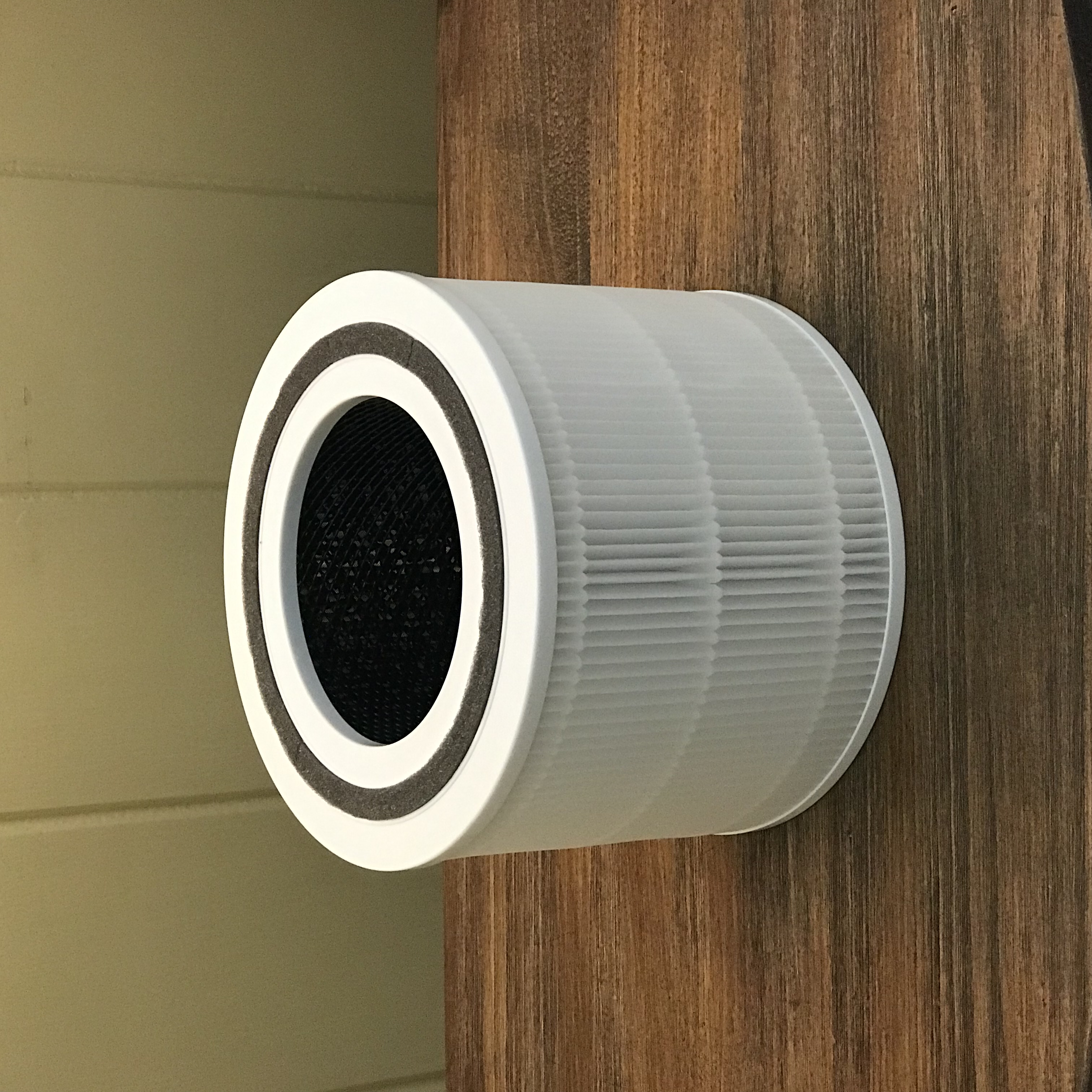
Cross-section of a circular HEPA filter showing the pleated filter media alongside an activated carbon layer. Image: Wikimedia Commons / CC BY-SA.
What HEPA Actually Means
HEPA stands for High Efficiency Particulate Air. The standard originated in the 1940s nuclear industry and was later formalized for consumer products. Under the US DOE definition, a true HEPA filter must capture at least 99.97% of particles at the most penetrating particle size (MPPS), which is 0.3 micrometres in diameter.
The 0.3-micron threshold deserves explanation. Counterintuitively, HEPA filters are least efficient at 0.3 microns, not at the smallest particle sizes. Particles smaller than 0.1 microns are captured by Brownian diffusion — they move erratically and collide with filter fibres. Particles larger than 1 micron are caught by inertial impaction and interception. The 0.3-micron range sits at a crossover point where neither mechanism is fully dominant, making it the hardest size to capture. A filter rated at 99.97% efficiency at 0.3 microns therefore exceeds that efficiency at both smaller and larger particle sizes.
The designation "HEPA-type" or "HEPA-like" is not standardized and carries no guaranteed efficiency rating. These filters are generally cheaper and less effective than certified true HEPA media.
MERV Ratings and Furnace Filters
The MERV (Minimum Efficiency Reporting Value) scale, defined in ASHRAE Standard 52.2, is used for filters in forced-air heating and cooling systems. The scale runs from MERV 1 (fibreglass panels that catch only large debris) to MERV 20 (used in cleanrooms).
For residential central-air systems, the relevant range is MERV 7 through MERV 16:
- MERV 7–8: Standard pleated filters. Capture most pollen (10–100 microns), dust mite debris, and mould spores. Airflow resistance is low.
- MERV 11–12: Capture finer dust, pet dander, and some smoke particles down to 1 micron at moderate efficiency. Suitable for homes with allergy concerns.
- MERV 13: Captures particles 0.3–1 micron at approximately 50–75% efficiency. Catches most bacteria, some virus-laden aerosols, and combustion particles. Recommended by Health Canada for households with respiratory conditions.
- MERV 14–16: Higher capture efficiency at sub-micron sizes. Suitable for high-end residential systems, but requires a blower capable of maintaining adequate airflow against the higher pressure drop.

A rectangular air purifier filter showing combined HEPA media and activated carbon layers. Image: Wikimedia Commons / CC BY-SA.
HEPA in Standalone Room Purifiers
Portable HEPA air purifiers work by drawing room air through a dense filter media. They are independent of the central HVAC system and can be placed in specific rooms — a bedroom for overnight use, or a home office if the central system doesn't adequately filter supply air.
The primary specification for a portable purifier is its Clean Air Delivery Rate (CADR), expressed in cubic feet per minute (CFM) or cubic metres per hour. CADR was developed by the Association of Home Appliance Manufacturers (AHAM) and reflects the volume of air cleaned per unit time for a specific contaminant (dust, smoke, pollen). A higher CADR relative to room volume means faster air cleaning.
Sizing for Room Volume
A rough sizing rule is that the purifier's CADR (in CFM) should be at least two-thirds of the room's square footage. For a 20 m² bedroom (approximately 215 square feet), a CADR of at least 143 CFM for smoke is a reasonable target. At that rate, the air in the room passes through the filter roughly 4–5 times per hour — a common recommendation for bedrooms and sleeping spaces.
Activated Carbon and VOC Removal
HEPA filters capture particulates but do nothing for gases or odours. Activated carbon (also called activated charcoal) adsorbs volatile organic compounds (VOCs) — formaldehyde from building materials, benzene from household cleaning products, cooking odours, and tobacco smoke volatiles. Many room purifiers combine a HEPA stage with an activated carbon pre-filter or post-filter.
The carbon bed's capacity is finite. Once the carbon becomes saturated, it stops adsorbing and may begin releasing previously captured compounds. Replacement schedules vary by manufacturer, but a common guideline is every 3–6 months for the carbon stage, compared to 12–18 months for the HEPA media in typical residential use.
Furnace Filter Replacement and Airflow
A common oversight in Canadian forced-air systems is allowing furnace filters to become excessively clogged. A clogged filter restricts airflow, which reduces heating and cooling efficiency, stresses the blower motor, and can cause the heat exchanger to overheat. The rule that a dirtier filter means better filtration is false: beyond a certain loading point, captured particles can break through or bypass the filter media.
Most residential furnace filters should be inspected monthly and replaced when visibly grey — typically every 1–3 months depending on occupancy, pets, and outdoor air quality. During wildfire smoke events, which have increasingly affected BC, Alberta, and parts of Ontario in recent summers, high-MERV filters can load very quickly and may need replacement after a few days of heavy smoke intrusion.
Check the static pressure rating of your furnace or air handler before upgrading to a MERV 13 or higher filter. Some older residential blowers cannot maintain adequate airflow against the higher resistance, which can cause the system to short-cycle or trip limit switches.
Contaminants and Particle Sizes
For context on what different filter grades capture:
- Pollen: 10–100 microns — captured by MERV 7 and above
- Mould spores: 1–30 microns — captured by MERV 8 and above
- Dust mite allergens: 0.5–50 microns — captured by MERV 11 and above
- Pet dander: 0.5–100 microns — captured by MERV 11 and above
- Wildfire smoke particulates (PM2.5): 0.4–2.5 microns — requires MERV 13 or HEPA for meaningful capture
- Bacteria: 0.3–10 microns — captured by MERV 13 and above